Hellgate 100K++
Natural Bridge Station, Virginia · December · 100K
- Distance
- 107 km (66.6 mi)
- Point to point
- Climbing
- 3,960 m (12,990 ft)
- Hilly: 37 m per km (195 ft per mi)
- Overall cutoff
- 18 hours
- 16:12 per mi (10:04 per km) average
- Finish rate
- 87%
- of starters in 2025
Why runners love it
- Midnight start, point to point through the Blue Ridge to Camp Bethel, with a free lodge for runners.
- Crew access at 6 of 9 aid stations, plus a pasta dinner and briefing the night before.
- 86.7% of starters finished in 2025 (124 of 143), against a tight 18 h limit.
- Counts as a Western States qualifier; sub-18 h finishers also get a Patagonia award.
- Course record 10:10:38 (2023); the Fearsome Five kept a 21-year finish streak.
Watch out for
- Two cutoffs: Floyd's Field (race mile 22.5 / 36 km (22.4 mi)) by 06:40, Bearwallow (42.5 / 68 km (42.3 mi)) by 12:30.
- The race publishes no elevation gain; unofficial figures run from 3,660 to 3,960 m (12,000 to 13,000 ft).
- Winter: -13 °C (8 °F) in 2016, snow in 2025; aid and crew points move when the Parkway closes.
- Entry is a committee application for runners with multiple 50 and 100 mi finishes; 150 starters, no waitlist.
- Leaves up to 46 cm (18 in) deep hide loose rocks in the Bearwallow Gap section.
Race
How runners feel about it, how well it is run, and the community around it. Counts for 25% of the overall score.
Toughness for its distance: Very tough
- Runner satisfactionBucket list4.5
Accounts from 2007 to 2025 treat it as a rite of passage; harsh weather and tight cutoffs are accepted as part of its appeal. · High confidence
- OrganizationWell run3.9
24 years of volunteer-run experience, a clear application, pasta dinner, briefing and van shuttle; entry is on paper and aid points can move. · Medium confidence
- Community and vibeLegendary4.8
Free Camp Bethel lodge, pasta dinner and briefing the night before, Horton greeting finishers and a 21-year streak by the Fearsome Five. · High confidence
Support
Aid stations, crew access, drop bags and pacer rules. Counts for 25% of the overall score.
- Aid stationsStandard3.0
9 stations over 66.6 mi (107 km); segments up to 8.8 mi (14.2 km), and a 19 mi (31 km) gap in 2025. · Medium confidence
- Crew accessGood3.5
Crew can reach 6 of 9 aid stations, along gravel Forest Service roads at night and a long drive from the finish. · High confidence
- Drop bagsOne or two1.9
Two drop bag stations only, one bag per runner carried from 22.5 to 42.5 race miles, and only for runners without a crew. · High confidence
- PacersNot allowed1.4
The application says nothing about pacers and no runner report mentions one; plan on running without a pacer. · Low confidence
Course
Course marking, scenery, and how runners rate the trail itself. Counts for 15% of the overall score.
- Course markingMostly clear3.3
Orange blazes on the Glenwood Horse Trail plus reflective streamers at tricky night turns; deep leaves and darkness worry runners. · Medium confidence
- SceneryBeautiful3.5
Waterfalls, Devil's Marbleyard and Parkway crossings, but the first 6.5 to 7 h are in the dark. · Low confidence
- Trail experienceGreat4.0
Runners describe rugged named sections like the Devil Trail, but also deep leaves, ice and long gravel climbs. · Medium confidence
Course traits, not part of the score
- FootingModerate2.6
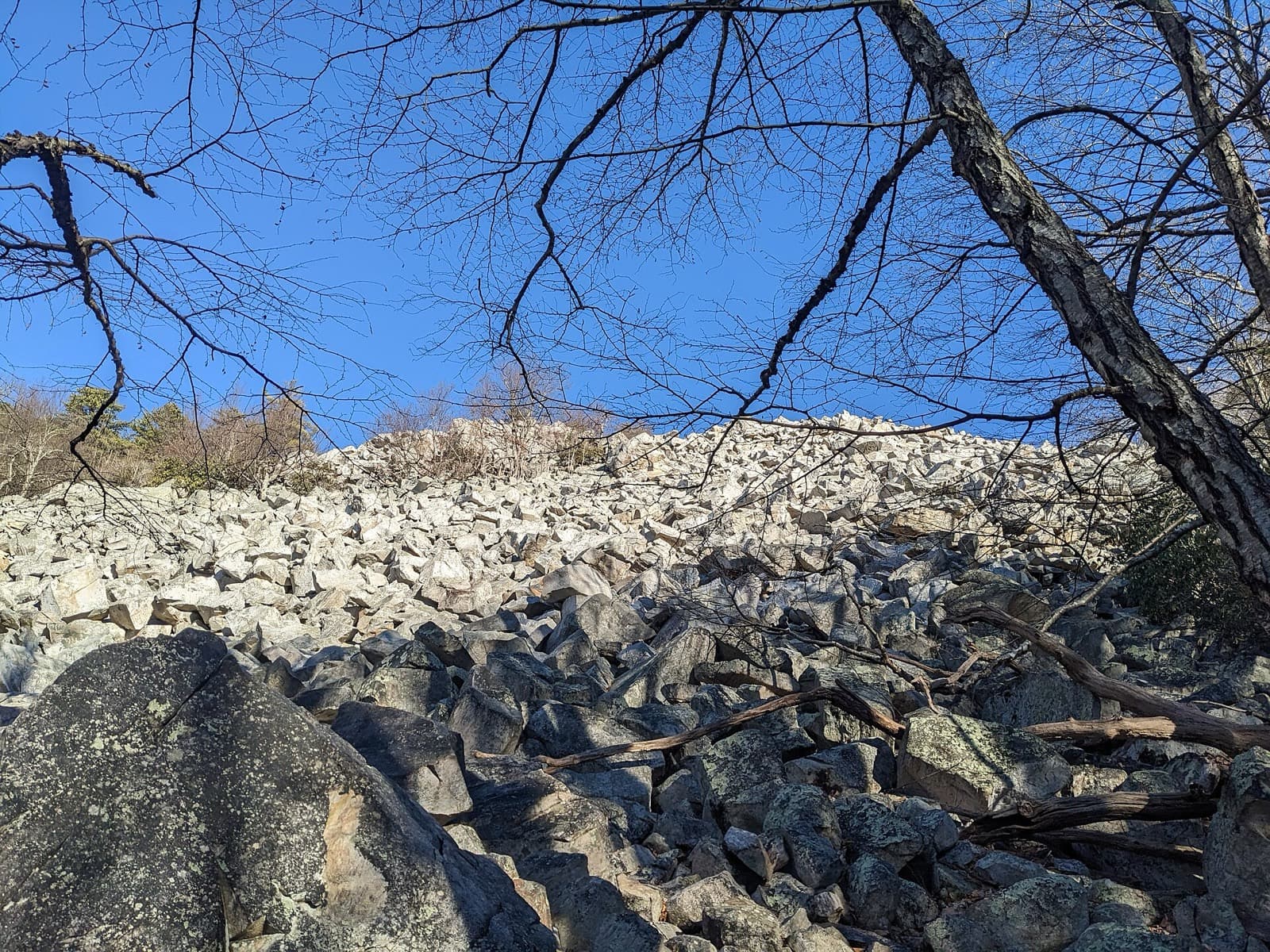
Gravel, grassy road and double-track early, then rocky leaf-covered singletrack with loose rocks hidden under the leaves. · Medium confidence
- RunnabilityMixed3.4
Sophie Speidel calls it runnable and hill-repeat friendly; long gravel climbs get walked and poles help after Bearwallow. · Medium confidence
- ClimbingHilly2.0
Climbs 195 ft per mi (37 m per km), from the official elevation gain. · High confidence
Conditions
Race-day temperature and how predictable the weather is. Counts for 14% of the overall score.
- Race-day temperatureHarsh1.6
December midnight start, typical lows -7 to 4 °C (20 to 40 °F), with a history of snow, ice and -13 °C (8 °F). · High confidence
- Weather reliabilityUnsettled1.8
Snow in 2003, 2005, 2017 and 2025, freezing rain in 2021 and some mild years; aid points move when the Parkway closes. · High confidence
Course traits, not part of the score
- AltitudeLow3.8
Blue Ridge crests around 1,000 m (3,300 ft); the race does not publish a high point. · Low confidence
Cutoffs
How generous the overall and intermediate cutoffs are for the terrain. Counts for 13% of the overall score.
- Overall cutoffNormal2.7
18 h for 66.6 mi (107 km) is about 16 min per mile (10 min per km) over rolling climbs; 87% finished in 2025. · Medium confidence
- Intermediate cutoffsTight2.3
Two cutoffs, at race miles 22.5 and 42.5, sit near the finishing pace with little cushion; many hit a low at Bearwallow. · Medium confidence
Intermediate cutoffs (2026 application and race page)
| Where | Distance | Cutoff |
|---|---|---|
| Headforemost Mountain / Floyd's Field (mile 22.5) | 36 km (22 mi) | 06:40 (6:39 elapsed) |
| Bearwallow Gap (mile 42.5) | 68 km (43 mi) | 12:30 (12:29 elapsed) |
Not part of the score
- First timer friendlyDemanding1.5
The race expects multiple 50 mi and 100 mi finishes; a midnight start, winter cold and a tight clock suit experienced runners. · High confidence
- Getting inHard1.8
Committee-judged application in two batches, 150 spots, no waitlist, and the field is chosen on experience. · High confidence
Stay and travel
Getting there, places to stay, race-day logistics and value. Counts for 8% of the overall score.
- Travel easeAwkward2.4
Rural Rockbridge and Botetourt counties; the race does not state the nearest airport or its distance. · Low confidence
- Places to stayGood4.2
Free Camp Bethel lodge for runners and crew after the race, showers at the finish, and hotels near the start used by some. · Medium confidence
- LogisticsSome complexity2.6
Point to point: a 26.8 mi (43 km) van or car trip to the start at 22:50, and crews hopping gravel roads at night. · High confidence
- ValueGood value4.4
$270 to $300 includes pasta dinner, lodge, showers, post-race chili and a Patagonia award for sub-18 h finishers. · Medium confidence
Key facts
Checked against the 2026 application and race page edition on the official race site. Rules change, so confirm before you enter. Blank means the race does not publish it.
- Location
- Natural Bridge Station, Virginia, United States
- Region
- Mid-Atlantic US
- Typical month
- December
- Latest or next date
- 12 December 2026
- Start time
- 00:01
- First held
- 2003
- Distance
- 107 km (66.6 mi)
- Course shape
- Point to point
- Surface
- Trail: Glenwood Horse Trail (marked with orange blazes), Forest Service gravel and grassy roads, double-track and singletrack, with short paved crossings at Highway 43 and the Blue Ridge Parkway (Schwartzbard course overview).
- Footing
- The race does not publish an elevation gain. The 13,000 ft (3,960 m) used here is cited by Lynchburg Living (2022) and Strambecco; Blue Ridge Outdoors (2017) says about 12,000 ft (3,660 m). Footing is long gravel and grassy road climbs early, then rockier singletrack later (Bearwallow Gap section has loose, jagged rocks hidden under deep leaves). The course crosses the Blue Ridge Parkway four times and the Appalachian Trail four times. Horton miles differ from GPS: the official course list reaches the finish at 62.5 mi while GPS gives 66.6 mi (107.2 km).
- Elevation gain
- 3,960 m (12,990 ft)
- Climbing rate
- 37 m per km (195 ft per mi)
- Overall cutoff
- 18 hours
- Pace to make the cutoff
- 16:12 per mi (10:04 per km)
- Cutoff notes
- Two cut-offs, reach each by the stated time or you are stopped (2026 application). Mileages are Horton miles, which run about 6 percent shorter than GPS, so the cut-offs fall at roughly 24 mi (39 km) and 45 mi (72 km) by GPS. The Floyd's Field cut-off may move if the aid station is relocated. Start 00:01, so 18 h means finishing by 18:01 Saturday.
- Aid stations
- 9
- Drop bags
- Some stations
- Crew access
- Most points
- Support notes
- Nine aid stations planned. Crew allowed at all except the 1st, 3rd and 6th. Drop bags only at Floyd's Field (mile 22.5) and Bearwallow Gap (42.5): one bag per runner, carried between them, and only for runners without a crew. The application says nothing about pacers. The 2026 application does not give a longest gap; Schwartzbard's course overview lists the longest segment at about 8.8 mi (14.2 km), and in the snowy 2025 edition a 19 mi (31 km) stretch had no aid and crews could not reach runners until mile 30 (48 km).
- Water crossings
- A few
- Water notes
- Several creek crossings, including one before the first aid station that almost guarantees wet feet; rocks at the first crossing can be icy (Schwartzbard).
- Night running
- Most runners run through one night
- Entry
- Qualifier
- Qualifier needed
- Application reviewed by the race committee, which accepts runners it thinks can finish within 18 hours. Multiple 50 mi and 100 mi finishes expected. Apply by mailed or emailed form with a check.
- Qualifies for
- Western States
- Entry fee
- About $270
- Field size
- About 150 runners
- Finish rate
- 87% of starters in 2025
- Air temperature
- -7–16 °C (19–61 °F)
- Weather notes
- Application: night 30 to 40 F (-1 to 4 C) and day 50 to 60 F (10 to 16 C) in mild years, or 20 to 30 F (-7 to -1 C) night and 30 to 40 F day in cold years. Extremes: 8 F (-13 C) in 2016, a foot of snow and teens F in 2003, freezing rain in 2021, snow and ice in 2025 (24 F / -4 C at the start). Dark until about 6:30 to 7:00.
- Nearest airport
- Not stated by the race; Roanoke (ROA) and Lynchburg are the nearest commercial airports we know of
- Stay notes
- Check-in, pasta dinner and briefing at Camp Bethel (Fincastle) on Friday; runners and crew may sleep at the Camp Bethel lodge for free after the race. Start is 26.8 mi (43 km) from Camp Bethel, a 30 to 35 min drive; vans run from Camp Bethel but drivers are told not to leave cars at the start.
- Course record (men)
- 10:10:38 Brian Culmo (2023)
- Course record (women)
- 11:59:06 Rachel Spaulding (2021)
Races like this
See every race ranked by likenessClosest on distance, course shape, climbing, footing, region and season.
 Pinhoti 1003.9
Heflin to Sylacauga, AL
Point to point or one big loop · Similar footing · Also in the Eastern US
Ohiopyle, PA
Also 100K · Point to point or one big loop · Also in the Eastern US
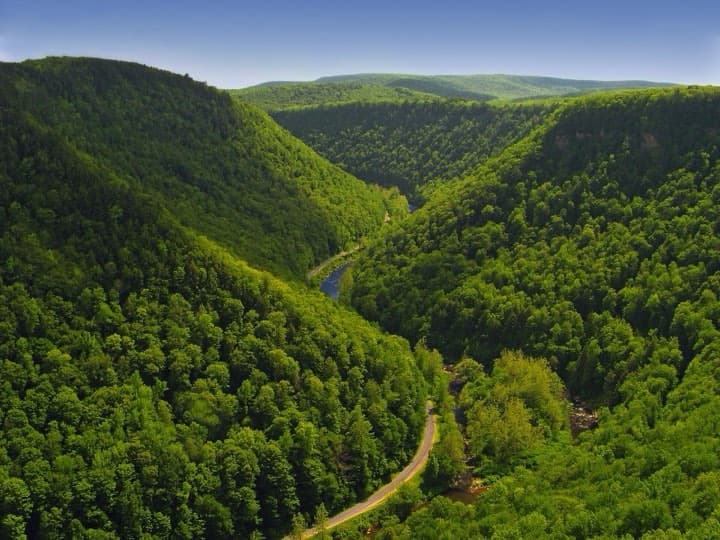
Waterville, PA
Point to point or one big loop · Similar climbing · Also in the Eastern US
What runners and reviewers say
- Believe in the RunRaced 2018 · blog · Positive
Finished 10th woman in about 15:40 in 18 F (-8 C) cold with a dusting of snow. Describes rocky, technical singletrack, leaf-covered ruts, an easy stream crossing, storm-damaged trees, and aid stations with Coke, Ensure, Tailwind and ginger candy. The first cut-off was around 06:30 and she arrived about an hour early; entry was by paper application, and runners are shuttled to the start.
“I was struggle-festing in the worst way.”
- Aaron Schwartzbard's Hellgate overview (vestigial.org)Raced 2014 · blog · Mixed
An 11-time finisher's course guide. Mostly gravel, grass and double-track with some paved crossings, long steady climbs early (about 1,200 ft / 365 m (1,200 ft) to Petites Gap), and a harsh, rocky stretch at Bearwallow Gap with loose rocks hidden under leaves. He lists nine aid stations and calls Bearwallow the second cut-off where many runners hit a low.
“I wondered how I could have forgotten just how difficult the race was.”
- iRunFarRaced 2007 · article · Mixed
Powell's 2007 preview describes a long, hilly, rocky course buried under leaves more than a foot (30 cm) deep, ice from a recent storm, and Horton's friendly but sadistic race-director manner. He planned to use microspikes.
- VHTRCRaced 2023 · article · Positive
Retrospective on 20 years: first edition had 71 starters and 40 finishers in 20 F (-7 C) icy conditions, entry is still by paper form with about 140 starters (the Camp Bethel lodge capacity), and the cut-offs are tight so no one can linger at aid. She credits the race with teaching her training, night nutrition and pacing, and keeps a free post-race lodge and chili tradition.
- Lynchburg LivingRaced 2022 · article · Positive
Feature on Horton's race: midnight start, about 150 runners from 30 or more states, about 13,000 ft (3,960 m) of gain, nine aid stations, an 18 h cap, and about 90 percent finishing. Weather has ranged from 70 F (21 C) days to snow, with nicknames Watergate and Snowgate and frozen-cornea 'Hellgate Eyes' for a handful of runners each year.
“Hellgate is like a test at the end of each year”
Show 3 more
- Blue Ridge OutdoorsRaced 2017 · article · Positive
Covers the 15th edition in a 22 F (-6 C) start with snow and a closed Blue Ridge Parkway: about 12,000 ft (3,660 m) of climbing mostly on leaf-covered technical trail, the Devil Trail section, a mix of summer-camp and family-reunion energy, and Horton greeting finishers for hours. Registration was still on paper and field seeded by Horton.
“You have to earn it every time.”
- VHTRCRaced 2025 · article · Positive
The 2025 winner describes snow and ice at the start, microspikes, a newly announced 19 mi (31 km) stretch without aid and crews unable to reach runners until mile 30 (48 km). Horton said snow made staffing hard and the Park Service approved the race the morning before. She credits volunteers, her crew and the club.
- Trail RunnerRaced 2017 · article · Positive
Describes long climbs, open views, technical terrain and smooth running over a course that shifts with late-season weather, with the Forever Trail named as a key section. Entry is semi-invitational, selected by Horton from applications, capped at about 140; family-style meal, bunkhouse lodging and bonfires with chili afterward.
Ran Hellgate 100K++? Your notes on the footing, cutoffs and aid stations help the next runner decide.
Sources
Pages we used for facts and ratings.
Training for Hellgate 100K++? Moku Coach builds your plan around race day.